I have made this home page a place for my diary-type entries, with more creative writing and my 'Thoughts and Comments' section available using the tabs above...
Saturday, August 4, 2012
The Olympics comes to Skomer Island
The cliffs of Skomer are a long way from London and the excitement of the Olympic games, but this week we put together our own Olympic celebration; the SkOlympics. There were a mixture of events taking place through the week, from welly throwing to the round island race - a gruelling 6 km run around the Skomer coast. The mid-week swimming event in North Haven held some unexpected thrills, with a large bull seal taking a close interest in the progress of the competitors (too close for comfort in some cases!). In the end Bridget, one of the weeks volunteers, came out victorious, overcoming the tide and the wildlife to win by a big margin.
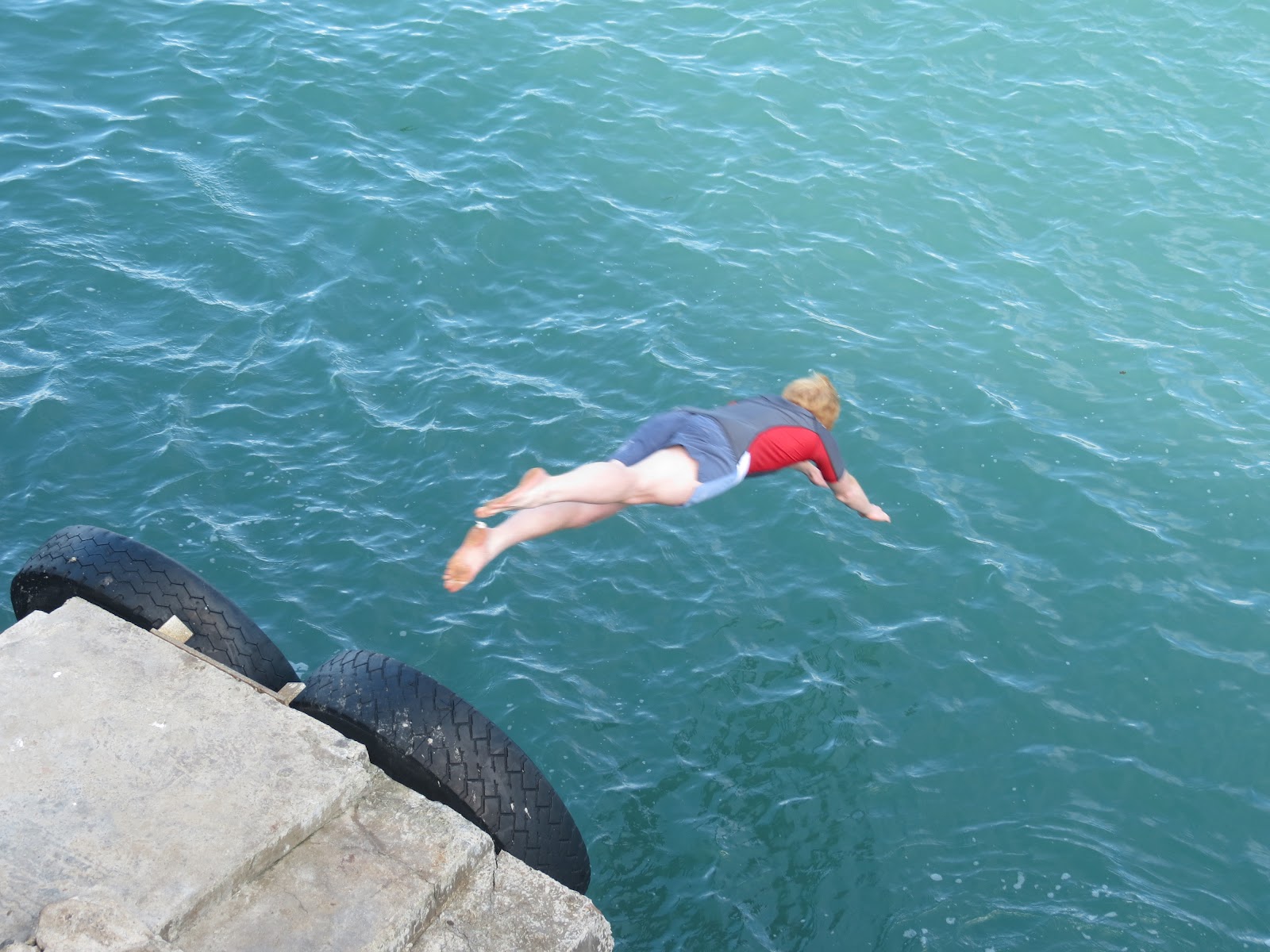
The last day of events yesterday looked in doubt for a while, as we struggled to put the obstacle race together in driving wind and rain. Luckily things brightened up, and the egg and spoon race, tug of war and obstacle race provided a good deal of entertainment. The tarpaulin obstacle was a unique challenge in the wind, but in the end everyone managed to find their way out! I finished with a bronze, although I opted for forward rolls instead of cartwheels for the gymnastics section! With a much more elegant effort Annette got the silver, with Dan (on the island for the week as a volunteer) coming in to claim gold.
The day ended with a medal ceremony in the picnic shelter, and a BBQ prepared indoors as a result of the worsening weather; Dan won overall (by a large number of points), I finished with silver and Lewis with bronze. So the Olympic spirit has not been absent from Skomer, and the backdrop of St Brides and the rugged beauty of the island have been a match for any state-of-the-art stadium in London!
Friday, July 27, 2012
A day trip to Skokholm
Today I had the chance to go over to Skokholm (the island to
the south of Skomer) a place I last visited as a volunteer several years ago. Chris was attending a meeting marking the
handover of the lighthouse to the Wildlife Trust, and there was a spare space
on the boat. It was my first trip on the
fast rib that carries sightseers around the islands; skimming the grey waves we
sped through the swirling waters of Little Sound and away from the cliffs of
Skomer. To the north a yacht navigated
her way between Skomer and the Mew Stone, and further out the Irish ferry made
its stately progress towards Pembroke. Quickly
we drew close to Skokholm. The rocks of
the island are a mixture of warm pink sandstone and black basalt, and rounding
its eastern tip the cliffs angle down into the sea in jagged shards,
spectacular to see.
Skokholm is smaller than Skomer, similar to its larger
neighbour to the extent that the centre is a plateau dominated by swathes of
bracken and rocky outcrops, but very different in geology and vegetation. Here Golden Rod is thick along the track from
the landing point, close to flowering, and along the cliff tops swathes of Wild
Pansy, in some places yellow, in others predominately blue, mix with scarlet
pimpernel and sea campion.
I left the main group at the lighthouse discussing the finer
points of the electrical circuitry, and headed out around the coast. It was hot and sunny, and I was glad of a
cool sea breeze as I skirted vertiginous cliffs of purple that dipped their
feet in a turquoise sea. I ate my lunch
at a place where fulmars swept along the coast on their stiff grey wings,
changing direction and pace with the slightest movement of their tail or
wings. Having plenty of time I drifted
to sleep, listening to the calls of choughs that chased acrobatically overhead.
Back at the farm at the centre of the island, where the
warden, two volunteers and any overnight guests stay, I had a look around. Compared to Skomer, Skokholm feels much more
isolated, the facilities much more basic and traditional. In the communal dining room (called ‘The
Wheel House’) there are many prizes stripped from a grounded schooner many
years ago (the crew having been safely evacuated); the whole place has a
tranquil, homely feel. In the sheltered
garden willow warblers flitted around the walls and hid amongst the Fuschia
bushes, and there was real heat from the sun.
All too soon it was time to return to the boat, setting off from South
Haven, where huge seals basked, gleaming in the sun by the light-flecked water.
Tuesday, July 24, 2012
The sun reaches Skomer!
The calm, turquoise waters of North Haven are
now more tempting for swimming than the steel grey seas that rolled below dark
skies earlier in the season, and the puffins still raft under the lea of the
cliffs (although their stays on land are becoming less frequent, their
attention drawn back to the open ocean now that most of their chicks have
fledged).
Sunday, July 15, 2012
Chicks fledge and the ledges empty
In the Kittiwake colonies large chicks are crammed into nests that now barely accommodate them. When their wings have grown long enough I will survey them for a final time, to count those that have successfully reached fledging age; the trick is to visit when they are just large enough, but before they start flying away!
Yesterday I swam for the first time in several days; the sea was warm, but full of jellyfish. At first it was disconcerting to push forward only for my hand or leg to brush against these soft, fleshy creatures, but I realised from a glance under water that they were moon jellyfish; a non-stinging variety. I swam with my head down, through my goggles seeing the jellies pulsing their way through the murk with gentle contractions of their rounded bodies. Their opaque forms seemed to glow in the shafts of sunlight from the world above, their gentle progress slipping them slowly past me in the turquoise, silent sea.
On the far side of the bay, where the puffins raft, one of the birds dived just ahead of me. Ducking under quickly I saw it zig zagging powerfully downwards, silver bubbles of air streaming behind it, propelled by its powerful stubby wings - soon it disappeared into the haze below, and I was suddenly aware of the depth that I drifted above; it will seem strange when these birds have left the island again for the open ocean.
Sunday, July 8, 2012
Puffin Chicks
On Wednesday I headed down to North Haven to help Dave, who has been catching and ringing puffin chicks over the last few days. Many of the 'pufflings' are ready to fledge, and some have already left, flying from the cliff tops, over St Bride's Bay and away for a winter far out in the Atlantic - exactly where and how they spend the long months before they return again in April is unknown. The catching method requires some skill, using a wire inserted deep into the long, twisting burrows to feel for and extract the chicks. The birds are not harmed, and are quickly ringed and returned to the safety of their homes.
The first chick here is quite young; still downy, and a couple of weeks or so from leaving the nest. He was the only chick I managed to catch! The second picture (below) is of a chick with well-developed plumage, resembling an adult in all but facial and beak colour and probably ready to fledge.
Monday, July 2, 2012
Watching the jumplings - guillies and razorbills fledge at High Cliff
Night has fallen over the island, the last of the light draining away below streamers of dark cloud. I have just got back to the farm, after spending the evening at High Cliff with Tom, Ali and Jasper, watching the guillemot and razorbill chicks jumping into the sea. The offspring of both species leap flightless from their ledges (they are referred to as 'jumplings') bouncing down the rocks to the waves below. We watched from the shoreline, close to rafts of adult birds waiting for their own chicks to take the plunge. The female stays on the ledge to coax the reluctant chick to the edge of cliff, while the male calls from the water below; the still air was filled with the cheeping of the young, and the encouraging calls of their parents.
When the chicks jump, they fall fast, seemingly impervious to heavy knocks against the cliff face, some even emerging unscathed from falls onto the black basalt boulders that line the shore here. We watched as, one after another, they hit the water with a splash, surfaced and raced out into the choppy grey expanse of the bay, adults leaving the main group to collect them.
At either end of the cliff, a Great Black Backed gull watched proceedings balefully. Scanning the water, I returned my gaze to one of these two, to find it shaking a helpless chick in its heavy bill. The gull took a long time over its meal, initially unable to swallow it, spending time softening it up, before tipping the improbably large morsel straight down its gullet, to sit with a huge lump in its throat for several minutes.
The gulls were not the only predator at watch on the cliffs. Peregrines have nested high up in one of the crevices in the rocks, and two gazed down from above, occasionally diving with breathtaking pace towards the water below - we did not see them make a catch, but undoubtedly it was only a matter of time before they would.
As evening turned to night we dragged ourselves away from the drama unfolding before us, making our way up the steep escarpment as the light at St Annes flashed across the bay, with the dark forms of puffins flitting through the air around us. A good end to the day.
Sunday, July 1, 2012
Stormy seas and gas bottles
| Puffins relax near me at the Wick, sheltering from the wind |
Its been a busy week on Skomer, and again I look out of the
kitchen window at driving rain and a grey blanket of cloud beyond the farm
wall. Yesterday we tried a swim – out of
the wind it is warm and humid – but once out in the bay we found the swell greater
than we had expected. It was
exhilarating, but a little worrying, to look down into wide, grey troughs of
broken water, and in the next moment be sliding down into them, the puffins rising and falling along with us, as unconcerned as in a flat
calm. Although the surface was rough,
the sea was no colder than usual, and by swimming at an angle to counter the
current we got back to the steps without too much incident – but with a bit of
adrenalin running through our veins!
| Chris pilots the rib to the landing steps |
The poor weather means that the guillie and razor chicks
have struggled to find a tranquil time to fledge, and as a result the ledges
are filled with over-sized chicks, barely able to hide under their parent’s
wings. While the weather was still fairly calm we
managed to transfer some gas bottles onto the island; Chris, Sarah, Lewis and I
heading out into the mist on the island rib, which powers fast over the waves,
spray flying; very different to the sedate progress of the Dale Princess! We
only had ten bottles to collect, so it was a fairly easy assignment, rolling
the heavy metal cylinders down the beach at Martin’s Haven and man-handling them
into the boat. On the way to the shore
we stopped by the Princess, and exchanged greetings with the Springwatch team, who
were visiting to film a few shots, a follow-up to last year’s program. With Television in mind, I will sign off now
– the final of the Euros begins soon, and people from North Haven and the farm
are gathering round the small portable TV; the type of communal viewing common to island
life, that on the mainland is now a thing of the past...
| Gas bottles on the beach at North Haven, ready for the tractor to pick up |
Subscribe to:
Posts (Atom)